Focus on the Future: Mastering Smartphone Photography in 2026
Today, the lens on your smartphone is more than just a camera; it is your eye on the world and your most powerful tool for self expression. For the ambitious Melita customer, a smartphone isn’t just for taking pictures; it is for capturing a vibe, building a brand and documenting a life in motion.
From the golden hour at the Upper Barrakka Gardens to the deep blue of the Comino lagoons, Malta is a photographer’s paradise. To do it justice, you need more than just megapixels, you need the right combination of optics, software and AI. This is your definitive guide to the smartphone camera systems currently leading the industry.
The Family Historian: Effortless Memories
For many, a smartphone’s true value is measured in point and shoot reliability. Whether it is a chaotic family lunch in Marsaxlokk or a child’s first birthday in Naxxar, you need a camera that reacts as fast as you do.
Apple: The King of Consistency
Apple’s iPhone 17 Pro Max and 17 Pro are designed for zero lag photography.
Fusion Camera System: The 48MP Fusion array ensures that skin tones look natural and motion blur is non existent.
Dual Capture: The latest 2026 feature allows you to record with both the front and rear cameras at the same time perfect for reaction style family videos.
Standard Models: For those who want simplicity, the iPhone 17, 17e and the ultra sleek iPhone Air deliver the same polished, easy to use experience that makes Apple the standard for family albums.
Samsung: The Everyday Versatile
The Galaxy A57 and A56 have redefined what value cameras can do. They offer multiple lenses that allow you to switch from a portrait of a relative to a wide shot of the festa decorations in an instant. For most families, these devices provide a high quality all rounder experience that is hard to beat.
The Scenic Explorer: Conquering the Maltese Landscape
Photographing the rugged beauty of Malta, the Sanap Cliffs in Gozo, the limestone bastions of Mdina or the sunset at Dingli, requires serious hardware. This is where lens flexibility and optical reach become essential.
Samsung: The Zoom Authority
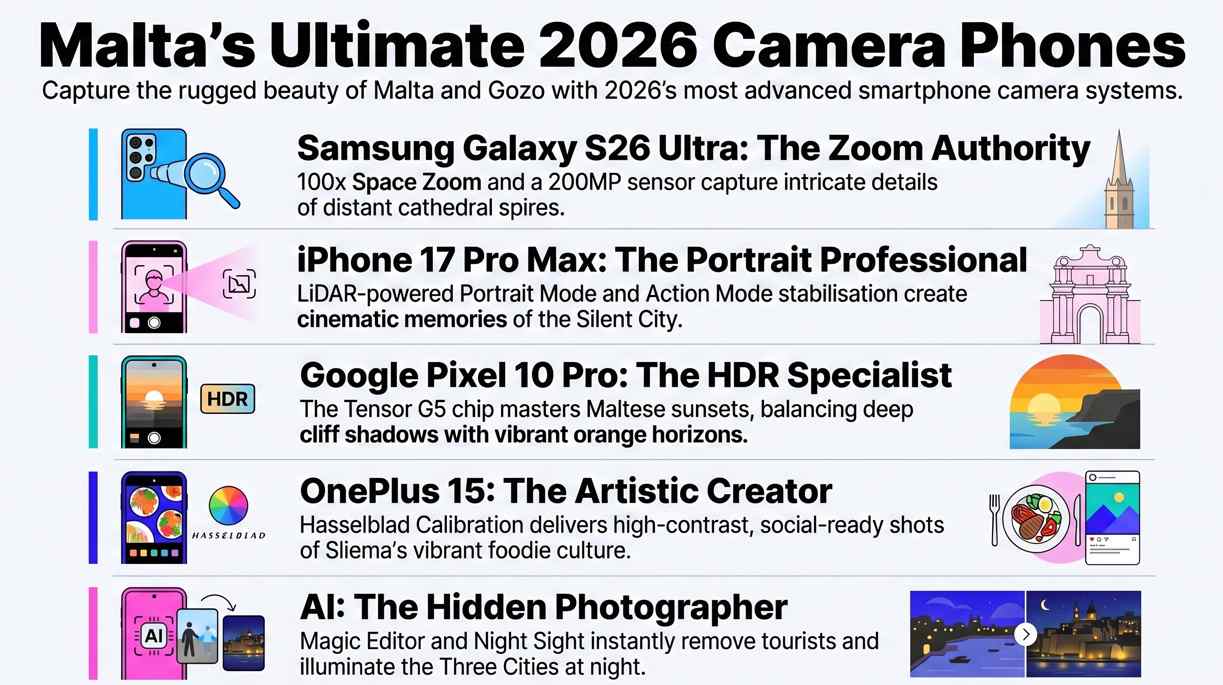
The Samsung Galaxy S26 Ultra remains the heavyweight champion of travel photography.
100x Space Zoom: Capture the intricate details of a cathedral spire from across the Grand Harbour.
200MP Main Sensor: Coupled with the Snapdragon 8 Elite Gen 5 processor, it offers unparalleled detail for wide landscape shots.
Privacy Display: A unique 2026 feature on the S26 Ultra that ensures only you can see the high resolution shots you are framing in crowded tourist spots.
Google: The Landscape Intellect
The Google Pixel 10 Pro uses its Tensor G5 chip to perform computational magic. It excels at High Dynamic Range (HDR) photography, ensuring that when you shoot a sunset, the shadows of the cliffs are just as detailed as the orange glow of the sky.
The Content Creator: Social Media and Foodie Culture
If your morning starts with a coffee shot in Sliema and ends with a Reel from a Valletta rooftop, your needs are specific. You need vibrant colours, sharp close ups and share ready processing.
OnePlus: Speed and Style
The OnePlus 15 and 15R have carved out a niche for creators who want dramatic, high contrast images.
Hasselblad Calibration: These phones offer a distinct look that makes food and lifestyle photography pop on a social feed.
7,300mAh Battery: Crucial for content creators, this massive battery ensures you can film, edit and post all day without hunting for a plug in Paceville.
Apple: The Portrait Professional
For influencer style content, the iPhone’s Portrait Mode is still the one to beat. It uses LiDAR and AI to create a bokeh effect that looks identical to an expensive DSLR lens.
The Video Revolution: Cinematic Life
In 2026 video is the dominant language of the internet. Whether you are filming a high end property tour, a travel vlogger’s vlog or just a video call with a friend abroad, stabilisation and low light performance are non negotiable.
iPhone 17 Pro: The Filmmaker’s Choice
The iPhone 17 Pro Max is effectively a pocket sized film studio.
External SSD Recording: Record directly to an external drive via USB-C, a feature now standard for creators in 2026.
Action Mode: Provides gimbal like stabilisation, making your handheld walking tours of the Silent City look as smooth as a Hollywood production.
Samsung: The Feature Powerhouse
The S26 Ultra supports 8K video at 30fps, allowing you to pull high resolution still photos directly from your video clips. It is the perfect tool for those who want the highest possible resolution for their memories.
AI: The Hidden Photographer
The most significant change in 2026 photography is not the glass; it is the AI. Your phone now sees what you are shooting and makes thousands of adjustments before you even press the button.
Now Nudge: A new feature on the Galaxy S26 series where AI suggests the best settings or edits in real time based on your surroundings.
Magic Editor: Photobombed by a tourist at the Blue Grotto? Google and Samsung now offer tools that let you circle and remove unwanted objects with absolute accuracy.
Night Sight & Nightography: Gone are the days of grainy night shots. Modern AI can stack multiple exposures in milliseconds, allowing you to capture the Three Cities at night with stunning clarity.
Quick Q&A: Your Camera Questions Answered
Q: Do more megapixels always mean a better camera?
A: No. While a 200MP sensor captures incredible detail, the software processing and sensor size are often more important for everyday shots. A 48MP iPhone photo can often look better than a 100MP photo from a lower tier device due to better AI balancing.
Q: Which phone is best for taking photos of my kids and pets?
A: The iPhone 17 Pro and Pixel 10 Pro are excellent here. They have the fastest shutter speeds, meaning they catch the moment before the subject moves and the photo blurs.
Q: Can I take good photos at night in Malta with a mid-range phone?
A: Yes! The Samsung Galaxy A56 and OnePlus 15R now feature dedicated Night Modes that produce social media ready shots of illuminated bastions and night markets.
Q: Is the 100x zoom actually useful?
A: It is a game changer for travel. While you might not use it every day, being able to zoom into a distant boat or a landmark on a Gozo cliffside adds a whole new dimension to your photography.
Q: What is “Computational Photography”?
A: It is the use of your phone’s processor to improve the image. It combines multiple shots, balances the lighting and sharpens the edges instantly. It is why a tiny phone lens can now compete with a giant professional camera.
The Final Verdict: Which Lens Matches Your Life?
Choose Apple if you want the most consistent video, the most natural portraits and a camera system that works perfectly every single time you tap the screen.
Choose Samsung if you want the ultimate zoom power, the most versatile lens setup and vibrant colours that are ready to post.
Choose Google if you want the smartest camera that uses AI to fix your mistakes and capture incredible low light detail.
Choose OnePlus if you want a fast, high performance camera with a unique artistic flair and a battery that never quits.
Your next masterpiece is waiting to be captured. Visit Melita today, test these camera systems for yourself and find the device that will help you tell your story.
Ready to capture the beauty of the islands? Explore our full range of 5G smartphones at Melita and find your perfect camera today.