For smartphone users in Malta, battery life is no longer just a technical specification—it is a daily necessity. Whether you are navigating the narrow streets of Mdina, sharing a 5G hotspot while working remotely in a Sliema cafe, or streaming content on the Gozo ferry, your device’s endurance is the foundation of your digital experience.
As we move through 2026, the way we use our phones has fundamentally shifted. High-refresh-rate displays, constant 5G connectivity and the explosion of on-device AI tools have pushed traditional lithium-ion technology to its limits. This guide explores why battery performance is now a primary buying factor and how new technologies are reshaping what we expect from our mobile devices.
Why Battery Performance is the New Industry Benchmark
In previous years, consumers prioritized camera megapixels or processor gigahertz. Today, for many in Malta, battery performance is the first thing they look at when considering an upgrade. This is because a phone that cannot last a full day of heavy use, including navigation between Valletta and St. Julian’s and frequent photography, is effectively a tethered device.
Furthermore, battery health is the leading indicator of a phone’s “useful life.” When a device begins to drain quickly under normal use or shuts down at 15%, it signals the end of that phone’s peak performance era. In a market where high-end smartphones are significant investments, longevity is king.
Capacity vs. Efficiency: Decoding the Specifications
One of the most common misconceptions in the smartphone market is that a larger battery (measured in milliampere-hours, or mAh) automatically equates to a longer-lasting phone. In 2026, the reality is far more complex.
The Role of Chipset Efficiency
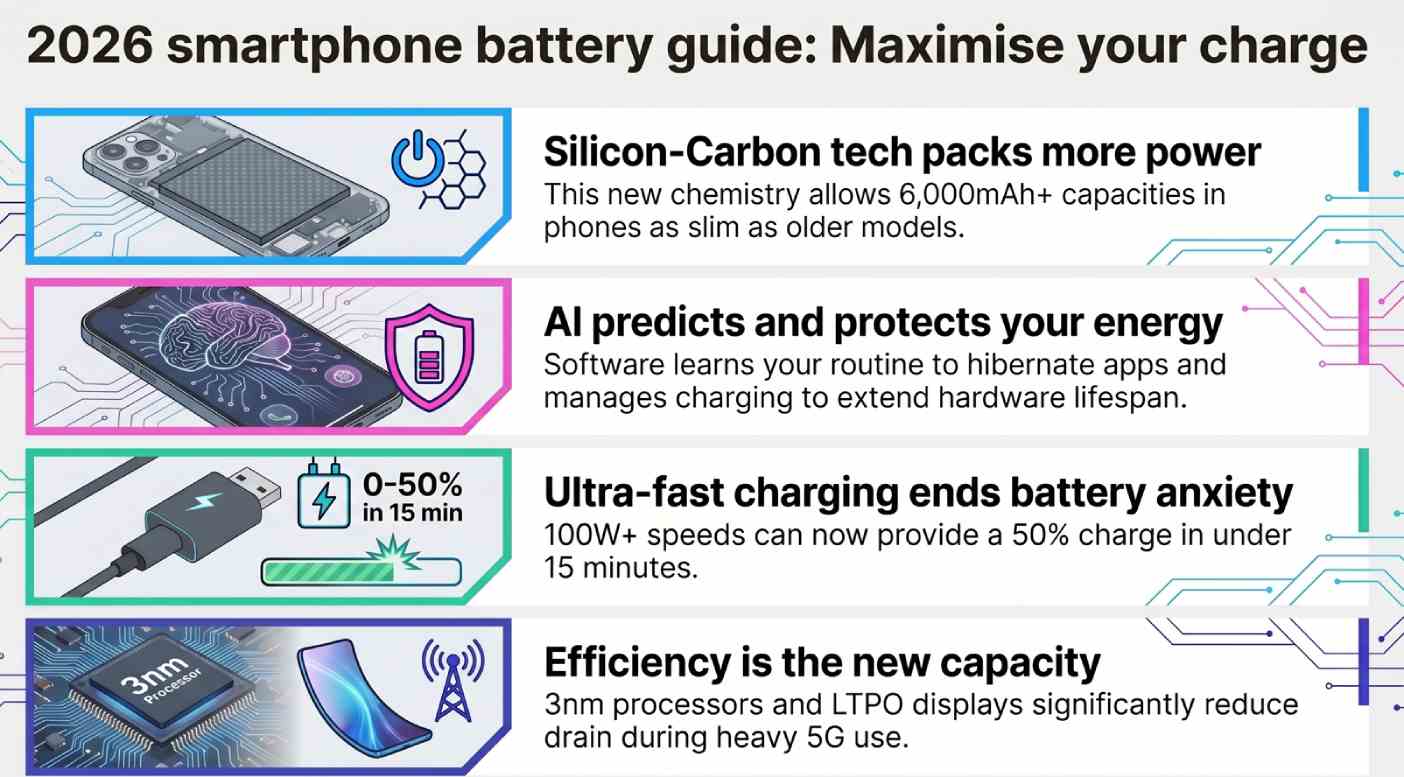
Modern processors, such as the latest Snapdragon 8 series or Apple’s A-series chips, are built on advanced 3nm and 2nm processes. These chips are designed to do more work while consuming less “juice.” This is why a phone with a 4,500mAh battery might actually outlast a 5,500mAh device that uses an older, less efficient processor.
Display Technology
The screen is the biggest power consumer. Modern LTPO (Low-Temperature Polycrystalline Oxide) displays can adjust their refresh rate from 120Hz down to 1Hz. If you are reading a static article in a park in Floriana, your phone saves massive amounts of energy by not refreshing the screen unnecessarily.
Software Optimization
Two phones with the exact same hardware can perform differently based on how their operating system manages background tasks. Effective software optimization limits “vampire apps”, those that stay active and drain power even when your phone is in your pocket.
2026 Tech Spotlight: Silicon-Carbon Batteries
If you are looking at the latest flagships in 2026, you will likely encounter Silicon-Carbon (Si-C) battery technology. This is the biggest leap in battery chemistry we have seen in a decade.
Traditional batteries use graphite anodes. By replacing or supplementing graphite with silicon, manufacturers can pack significantly more energy into the same physical space.
The Benefit: You get a 6,000mAh battery in a phone that is just as thin as a 4,500mAh phone from two years ago.
The Performance: These batteries offer higher energy density, meaning they handle high-drain tasks (like 4K video recording or AI processing) much better than traditional cells.
AI-Driven Power Management: The Invisible Saver
In 2026, your phone’s battery isn’t just a chemical tank; it has a brain. Artificial Intelligence now plays a massive role in extending your screen-on time.
Predictive Usage: Your phone learns your routine. If it knows you usually don’t charge your phone until 11 PM, it will aggressively manage background apps starting at 6 PM to ensure you have enough power to get home.
AI Charging: To protect long-term health, AI monitors your sleep patterns. It will charge your phone to 80% quickly, then wait until just before you wake up to trickle-charge the final 20%. This prevents the battery from sitting at 100% all night, which causes chemical stress.
NPU Efficiency: Modern AI tasks are handled by a dedicated Neural Processing Unit (NPU), which is far more power-efficient than the main CPU for tasks like live translation or voice recognition.
How Global Brands Approach Power
Every manufacturer has a different “vibe” when it comes to battery management. Understanding these can help you choose the right device for your lifestyle.
Apple: System Integration
Apple’s strategy is based on “Vertical Integration.” Because they design the hardware, the silicon, and the software, they can squeeze every possible second out of the battery. For a user in Malta who wants a predictable, consistent experience throughout a day of meetings in Valletta, iPhones are often the gold standard for reliability.
Samsung: Versatility and PowerShare
Samsung tends to lead in feature-rich battery options. Their Wireless PowerShare is a standout feature for many, allowing you to charge your Galaxy Buds or even a friend’s phone by placing it on the back of your device. This is incredibly useful during long summer days at Ghadira Bay when someone’s accessories inevitably run low.
Google: The Adaptive Learner
Google’s Pixel line relies heavily on “Adaptive Battery” technology. The phone literally gets better at saving power the longer you own it, as it learns which apps you rarely use and puts them into a “deep sleep.”
OnePlus: The Speed King
OnePlus (alongside brands like Oppo and Xiaomi) has revolutionized Fast Charging. While others might take an hour to charge, these devices can often hit a 100% charge in under 30 minutes. This is a game-changer for people who are always on the move and only have a few minutes to plug in between errands.
Fast Charging: The GOAT of Modern Convenience
The GOAT (Greatest Of All Time) feature for many mobile users is undoubtedly ultra-fast charging. It has changed the way we think about battery life. If you can get a 50% charge in the time it takes to drink a coffee in Naxxar, “low battery anxiety” virtually disappears.
Wired vs. Wireless vs. Qi2
Wired Charging: Still the fastest and most efficient. In 2026, we are seeing standard speeds of 60W to 100W on many Android flagships.
Wireless Charging: Great for convenience on a desk or nightstand.
Qi2 Technology: This is the new standard that brings magnetic alignment (similar to Apple’s MagSafe) to all smartphones. It ensures your phone is perfectly lined up with the charger, reducing heat and increasing efficiency.
The 2027 EU Mandate: A Revolution in Repair
A major shift is coming that every smartphone buyer in Malta should be aware of. By February 2027, EU regulations will require most smartphones to have user-replaceable batteries.
This is part of a broader “Right to Repair” movement. For the last decade, batteries have been glued inside phones, making them difficult and expensive to replace. The new rules mean:
Longer Ownership: When your battery naturally degrades after two or three years, you can simply buy a new one and swap it out yourself, rather than buying a whole new phone.
Sustainability: This will massively reduce e-waste across Europe.
Resale Value: Phones with easily replaceable batteries will hold their value much better in the second-hand market.
Hotspots and 5G: The Maltese Context
Malta’s robust 5G network is fantastic for speed, but it is a known battery killer. Using your phone as a hotspot—common for remote workers or those commuting between the islands—is one of the most power-intensive tasks you can perform.
Hotspot Pro-Tips:
Keep your phone out of the sun while tethering; the combined heat from 5G and the Wi-Fi broadcast can cause the phone to throttle its speed to cool down.
If you are on the ferry or a bus, use a wired connection to your laptop if possible (USB tethering), as it is more efficient than broadcasting a Wi-Fi signal.
Comprehensive Q&A: Your Battery Questions Answered
Q: What is the GOAT of charging methods in 2026?
A: Wired charging remains the GOAT because it offers the highest speeds (up to 100W+ on some models) and the least amount of energy loss through heat.
Q: Should I always charge my phone to 100%?
A: If you plan on keeping your phone for more than two years, try to stay between 20% and 80%. Lithium-ion batteries are under the most chemical stress when they are completely full or completely empty.
Q: Why does my phone get hot when charging?
A: Fast charging involves moving a lot of energy quickly, which naturally creates heat. However, if your phone gets too hot to touch, you should remove the case or check if you are using a low-quality third-party cable.
Q: Does Dark Mode actually save battery?
A: Yes, but only on phones with OLED or AMOLED screens (which most modern smartphones have). On these screens, black pixels are actually turned off, consuming zero power.
Q: What are “vampire apps” and how do I stop them?
A: These are apps that run in the background, constantly checking for updates or tracking your location. Go to your phone’s Battery settings and look for “High Background Usage.” You can manually “Force Stop” or “Restrict” these apps.
Q: Is wireless charging slower than wired?
A: Generally, yes. Even with the new Qi2 standards, wireless charging generates more heat and is less efficient than a direct cable connection. It is best used for overnight charging or at a desk.
Q: Will the new EU rules make phones thicker?
A: Possibly by a fraction of a millimeter. To make a battery removable, manufacturers need to use slightly more internal structure. However, with Silicon-Carbon tech making batteries thinner, most users won’t notice the difference.
Conclusion: Making a Future-Proof Choice
Battery technology has evolved from a simple power source into a complex ecosystem of hardware, software, and AI. When choosing your next smartphone in Malta, look beyond the mAh number. Consider the efficiency of the chipset, the speed of the charging technology, and the brand’s commitment to long-term battery health.
As we move toward a more sustainable future with replaceable batteries and AI-managed power, your phone is becoming smarter about how it uses every last drop of energy. By understanding these trends, you can ensure your device stays powered up for the long haul.
Looking for the latest in long-lasting smartphone tech? Browse our curated selection of 2026 flagships and find the device that matches your pace.