Fibre internet is the foundation of modern connectivity. It powers streaming, gaming, remote work, smart homes, cloud storage, CCTV, automation systems, and all the connected devices inside your home.
However, not all fibre installations are the same. Malta’s buildings, layouts, and historic construction introduce unique challenges, which make Melita’s approach to fibre especially important.
This guide explains everything, what fibre is, how it works, why it is better than older technologies, how it is installed in Malta, and how to get the best performance once fibre reaches your home.
1. What Fibre Internet Actually Is
At its core, fibre internet uses thin strands of glass, each about the width of a human hair, to transmit data using pulses of light. Light travels extremely quickly and loses very little strength over distance.
This makes fibre:
- Fast
- Stable
- Low latency
- Reliable
- Futureproof
Unlike copper based technologies such as ADSL, DSL, or coaxial cable, fibre does not degrade in the same way over distance or from electrical interference.
With Melita fibre, your home receives a direct optical connection into the network, allowing speeds from 250 Mbps up to 2,500 Mbps with very high stability.
2. Why Fibre Is Better Than Older Technologies
Older internet technologies relied on electricity travelling through copper wires. These systems were originally designed for telephone communication, not high speed data.
Fibre is superior because:
- Light travels faster than electrical signals
- Fibre can carry far more data at once
- It does not corrode over time
- It performs consistently over long distances
- It is not affected by electrical interference in the home
- It scales easily to support future speeds
If copper internet is like water flowing through a garden hose, fibre is like water moving through a large underground pipeline.
3. Fibre in Malta, Why It Is Different
Malta’s infrastructure and building styles are very different from most countries, so fibre deployment requires a more tailored approach.
Key Maltese factors:
- Dense cities and narrow streets
- Fibre routing often requires creative solutions such as building facades, shared ducts, roof paths, and corner access points
- Limestone construction
Limestone is durable and long lasting, but it introduces challenges such as drilling pathways, creating conduits, managing internal cabling, and protecting fibre from pressure or heat
- Mixed age buildings
Modern apartments in areas like Sliema differ significantly from traditional townhouses in places such as Żejtun or Rabat, so installations must be adapted to each property
- Nationwide scalability
Melita’s fibre network is designed to perform in high density areas while also delivering reliable service to more remote locations
4. How Melita Installs Fibre Into Maltese Homes
A typical fibre installation follows several key stages:
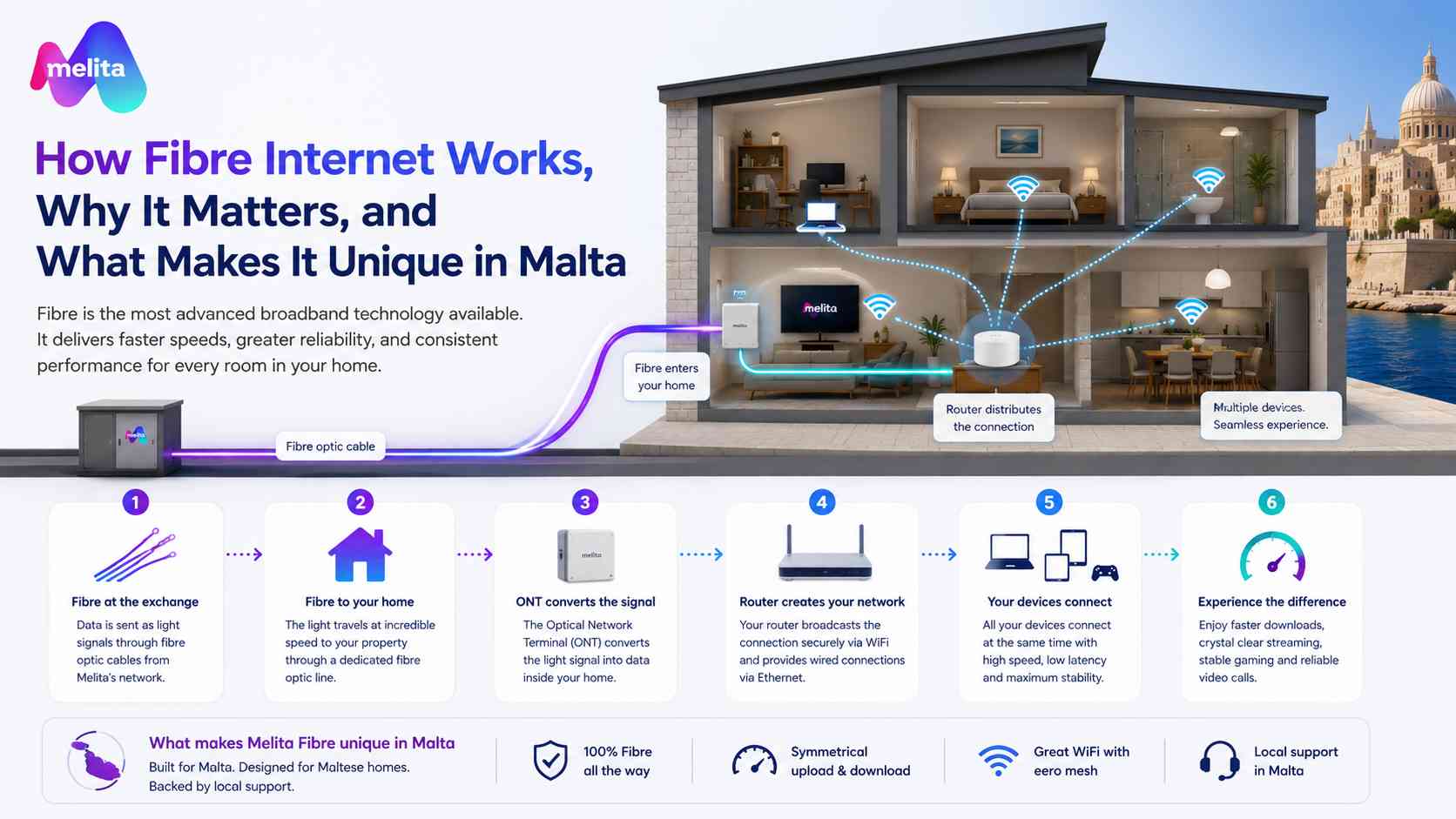
Stage 1, fibre reaches your street or building
Distribution points are installed along roads, inside apartment blocks, or across rooftops
Stage 2, fibre is routed into your home
The technician selects the most efficient path using existing conduits, wall trunking, skirting channels, or high level corner routes, with minimal drilling where necessary
Stage 3, termination point installation
A small optical terminal is installed inside your home where the fibre line ends
Stage 4, router connection
Your router or mesh system connects to the terminal, converting optical signal into usable internet
Stage 5, WiFi optimisation
Router and mesh placement are adjusted to ensure strong coverage throughout the home
5. FTTH vs Other Types of Fibre
Not all fibre connections are equal, and understanding the differences is important.
FTTH, Fibre To The Home
- True fibre connection directly into your home
- Fastest, most stable, and most reliable option
FTTC, Fibre To The Cabinet
- Fibre reaches a nearby cabinet, with copper completing the final distance
- Performance depends on distance and copper quality
FTTN, Fibre To The Node
- Fibre only reaches a central point, with older infrastructure completing the connection
- Slower and less consistent
Melita focuses on FTTH wherever possible to deliver the best performance.
6. Why Fibre Matters More in Limestone Homes
Limestone affects WiFi, not fibre, and this distinction is important.
Fibre delivers full speed directly to your router
Because it is optical and wired, fibre is not affected by:
- Signal absorption
- Distance within the home
- Electrical interference
- Weather conditions
WiFi, however, is strongly affected by limestone walls. This is why combining fibre with mesh WiFi is the ideal solution in Malta. Fibre brings maximum speed into your home, while mesh systems such as eero distribute that speed effectively from room to room.
7. How Fibre Improves Overall Network Stability
Even though WiFi is wireless, the quality of the underlying fibre connection plays a major role.
Fibre provides:
- More consistent speeds across devices
- Faster recovery during high usage
- Lower latency for gaming and calls
- Better performance for smart home devices
- Stable connections when many devices are active at once
- Fibre acts as the engine behind your entire home network.
8. Getting the Best Performance from Fibre
Practical advice is especially important in Malta, where home layouts vary widely.
- Position your router correctly
- Place your router in a central, open area
- Keep it above waist height
- Avoid placing it behind TVs, inside cabinets, or in corners
- Avoid locations such as utility rooms, under stairs, or inside stone recesses
- Use mesh WiFi for full coverage
- Limestone homes typically require multiple access points
- Place nodes room by room
- Keep them in open areas at similar heights
- Position them along corridors or landings for better signal flow
- Use Ethernet where it matters
- Connect key devices using cables, including TVs, gaming consoles, desktop PCs, office setups, and network storage
- Ethernet ensures full speed, low latency, stable uploads, and reduces strain on WiFi
- Keep devices up to date
- Older devices may not support higher speeds
- For faster connections, use devices that support WiFi 6 or WiFi 6E
- Ensure software and apps are updated
- Test your connection properly
- Use Ethernet with a Cat6 or Cat6A cable to verify full fibre speed
- Test WiFi near each node, room by room
- Make sure your device supports high speed connections
9. The Future of Fibre in Malta
Fibre is not just a current solution, it is the foundation of Malta’s digital future.
Melita’s network is designed to:
- Support increasing speed demands
- Enable 8K streaming and advanced media
- Handle growing smart home ecosystems
- Expand multigigabit connectivity
- Maintain consistent performance as usage grows
As more homes rely on connected devices, fibre is the only infrastructure capable of supporting this demand reliably.
10. Summary, Fibre Powers the Modern Maltese Home
Fibre is more than fast internet. It is the backbone that enables:
- Streaming
- Gaming
- Smart home systems
- Cloud based work
- CCTV
- Home offices
- Education
- Multiple connected users
- Everyday digital life
In a country built with limestone homes, combining fibre to the home with a well designed mesh WiFi setup ensures strong performance in every room. Melita’s fibre brings speed into your home. Your WiFi setup ensures that speed reaches every device.